Pages

Showing posts with label Discrimination. Show all posts

Wednesday, November 23, 2011

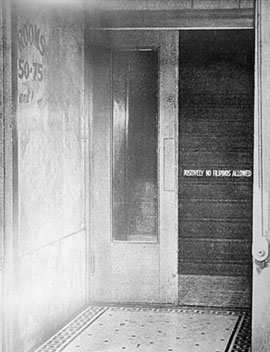
MUST READ ALERT: 8/22/11 California Apoligizes to all Filipino-Americans for fundamental violations of basic constitutional and civil rights

Luis Alejo


"Positively No Filipinos Allowed"


“RESOLVED by the Assembly of the State of California, the Senate thereof concurring, that the Legislature, on behalf of the people of the state, apologizes to Filipino-Americans in California for fundamental violations of basic constitutional and civil rights through de jure and de facto discrimination committed during the 1920s through the 1940.” – ACR 74, authored by Hon. Luis Alejo, August 2011, presented to the cast and crew of The Romance of Magno Rubio on Nov. 18, 2011 at Inside the Ford Theater in Hollywood.
 
Hon. Luis Alejo’s parents came to the United States under the bracero program, where a million workers were imported from Mexico to work in the farms of California in the 1950’s.
Although his father had 2nd grade education, his mother did not. His American dream came true and more -- he was elected as an Assemblymember, completed a Juris Doctorate degree at UC Davis, a Master’s of Education in Administration, Planning and Social Policy from Harvard University and earned two bachelor degrees in political science and Chicano Studies at UC Berkeley.

It was in Berkeley where he got exposed to the history of Filipinos in America, when he took a class in Ethnic Studies. It was a century-old story which he became curious about. He remembered his family’s neighbors, the Rosete Family, who took care of him. Their children played together, while his parents worked in the fields.

He learned at UC Cal about Larry Itliong, Philip Vera Cruz and other Filipino farmworkers who got increases of $1.40/hour from harvesting grapes in Coachella Valley, later sold at $14 a lug.
Philip Vera Cruz documented the farm workers’ union organizing activities in his book, “Philip Vera Cruz: a Personal History of Filipino Immigrants and the Farmworkers Movement, written with Craig Scharlin and Lilia Villanueva.

When these Filipino farmworkers travelled north to Delano, they got paid $1.15/ hour by the growers, who charged lodging and several weeks of farm labor were classified as training, henced unpaid, but they were already skilled yet, their work devalued, a case of double injustice, from the farmworkers’ perspectives.

Larry Itliong, one of the leaders of the Agricultural Workers Organizing Committee (AWOC) approached Cesar Chavez and Mexicans of the NFWA to join in with the Filipinos, or risk becoming scabs, compelled to cross the picket lines by the growers. Cesar Chavez said no, that the Mexicans were not ready. Filipinos started their own strike of the Delano grape fields for weeks, when Cesar changed his mind to join them, and the United Farmworkers Union was born out of these combined efforts.

Full article here at Asian Journal......

Wednesday, October 7, 2009

Benevolent Assimilation and Paternalistic Racism

On the seventh day of Filipino American History Month, it is a pleasure to share the following Filipino American history.

As early as December 21, 1898, President William McKinley set the tone for how the government of the United States of America viewed the Philippines and its people. On that day, he proclaimed:

…it should be the earnest wish and paramount aim of the military administration to win the confidence, respect, and affection of the inhabitants of the Philippines by assuring them in every possible way that full measure of individual rights and liberties which is the heritage of free peoples, and by proving to them that the mission of the United States is one of benevolent assimilation substituting the mild sway of justice and right for arbitrary rule. In the fulfillment of this high mission, supporting the temperate administration of affairs for the greatest good of the governed, there must be sedulously maintained the strong arm of authority, to repress disturbance and to overcome all obstacles to the bestowal of the blessings of good and stable government upon the people of the Philippine Islands under the free flag of the United States.


While the government of the United States of America declared the Philippine-American War over by 1902, guerilla resistance movements against the American occupation continued until 1913.

"Little Brown Brother" was a term used by Americans to refer to Filipinos. The term was coined by William Howard Taft, the first American Governor-General of the Philippines (1901-1904) and later the 27th President of the United States. The term was not originally intended to be derogatory, nor an ethnic slur.

Taft told President McKinley that "our little brown brothers" would need "fifty or one hundred years" (note that the Philippines became independent of the United States of America in 1946, about 50 years after the Philippines was ceded by Spain) of close supervision "to develop anything resembling Anglo-Saxon political principles and skills. Fillipinos (sic) are moved by similar considerations to those which move other men." The phrase "Little Brown Brother" drew some sneers from both Americans and Filipinos, however, due to the bloodshed of the Philippine-American War.

During this same time period, Rudyard Kipling published a poem in 1899, entitled “The White Man’s Burden.” The subtitle was “The United States and the Philippine Islands.” The term is often interpreted to mean that White people have an obligation to rule over and encourage the cultural development of people from other ethnic and cultural backgrounds until they can take their place in the world by fully adopting Western ways.

These concepts were all aligned with the ideology of manifest destiny, that the United States was destined, even divinely ordained, to expand across the North American continent, from the Atlantic seaboard to the Pacific Ocean and beyond. Altogether, in the words of historian Creighton Miller, they were a reflection of "paternalist racism," which has arguably echoed into the present-day.

Happy Filipino American History Month!

Thursday, April 16, 2009

The School on Gender Rights for Filipina Domestic Workers

In New York, the Gabriella Network (GABNet) of the Mariposa Alliance and the Damayan Migrant Rights for Filipino Domestic Workers. It is the first of its kind in the nation and aims to teach Filipino women how to deal wth situations pertaining to gender rights and safety, gender violence, and gender discrimination.

A prominent advocate for women's rights, the GABNet has long been ahead of the curve when it comes to innovative forms of activism. Their worldwide network is extensive, multigenerational, and multicultural.